
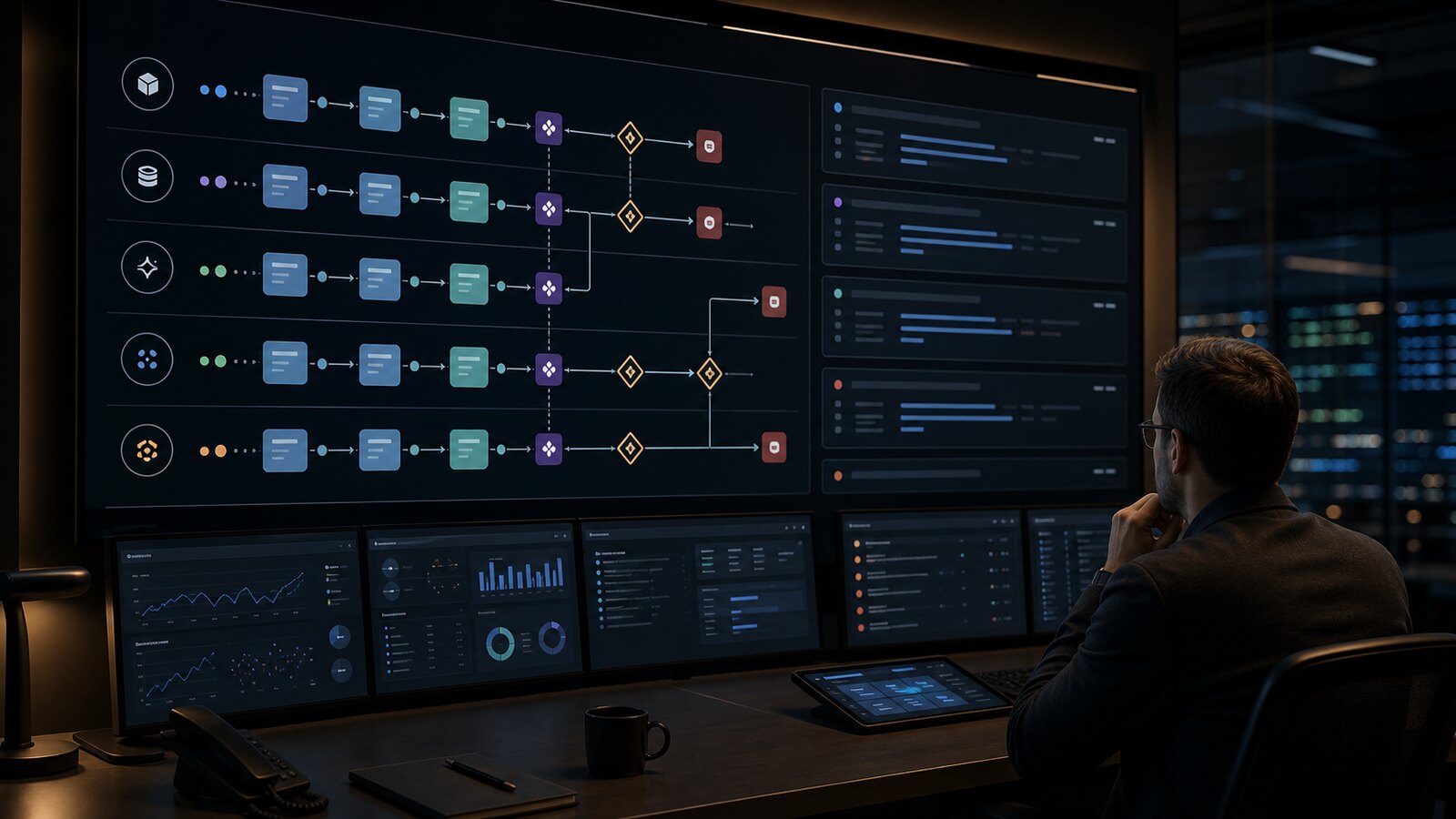
The Problem Changes Once Agents Are Part of Delivery
A single agent run can be managed informally. Once the work becomes repeated, multi-step, or parallel, the problem changes. The team stops asking “what should the prompt say?” and starts asking “which run is active, what completed, what failed, and how do we resume safely?”
That is the point where orchestration stops being prompt craft and becomes operations design.
Why Prompt Quality Is No Longer the Center of Gravity
Good prompts still matter, but they are not the core bottleneck once agents are handling recurring work. The harder questions are operational: what state exists for each run, what logs are available, how are failures surfaced, which steps can be retried, and where does a human take over when judgment is required? Without those answers, every multi-agent workflow is harder to trust than it is to launch.
This is why “AI agent orchestration” often sounds more mature than it really is. A lot of systems can start runs. Far fewer can supervise them responsibly.
What the Runtime Actually Has to Provide
A real orchestration layer needs run state, event history, start/stop controls, visibility into what the agent is doing, and a durable path to hand work back to a person. It also needs restart boundaries. If a long workflow fails halfway through, the operator needs to know what completed, what is safe to re-run, and what should remain untouched.
Those are not prompt concerns. They are runtime concerns. They are what make agent work governable instead of theatrical.
Why Logs and Visibility Matter So Much
Teams lose trust quickly when agent work disappears into a black box. Logs, run slices, artifacts, and operator-visible status views matter because they turn the system into something that can be supervised. Once the operator can inspect the workflow, agent output becomes easier to adopt because failure stops looking mysterious.
This is one of the main dividing lines between experimentation and production use. Production systems create evidence about what happened.
Where the Commercial Value Appears
The more often agents are used across projects, the more valuable orchestration becomes. Visibility and control save more time than another clever prompt once the environment is handling recurring delivery tasks. That is especially true when agent work crosses code, content, SEO, QA, and operations surfaces that already need auditability.
Reliable orchestration does not make the intelligence smarter by itself. It makes the intelligence operationally usable.
The Decision Rule
If agents are part of real delivery rather than experimentation, treat orchestration like operations. Queue control, logs, restart boundaries, and handoffs are what make the intelligence safe to run at scale.